Her Diagnosis
Iris has one of the rarest mitochondrial diagnoses ever documented — and she has already outlived the expectations set for her. This page explains her MRPL39 mutation and Leigh Syndrome in plain terms, and includes the scientific detail clinicians need to understand how they might help.
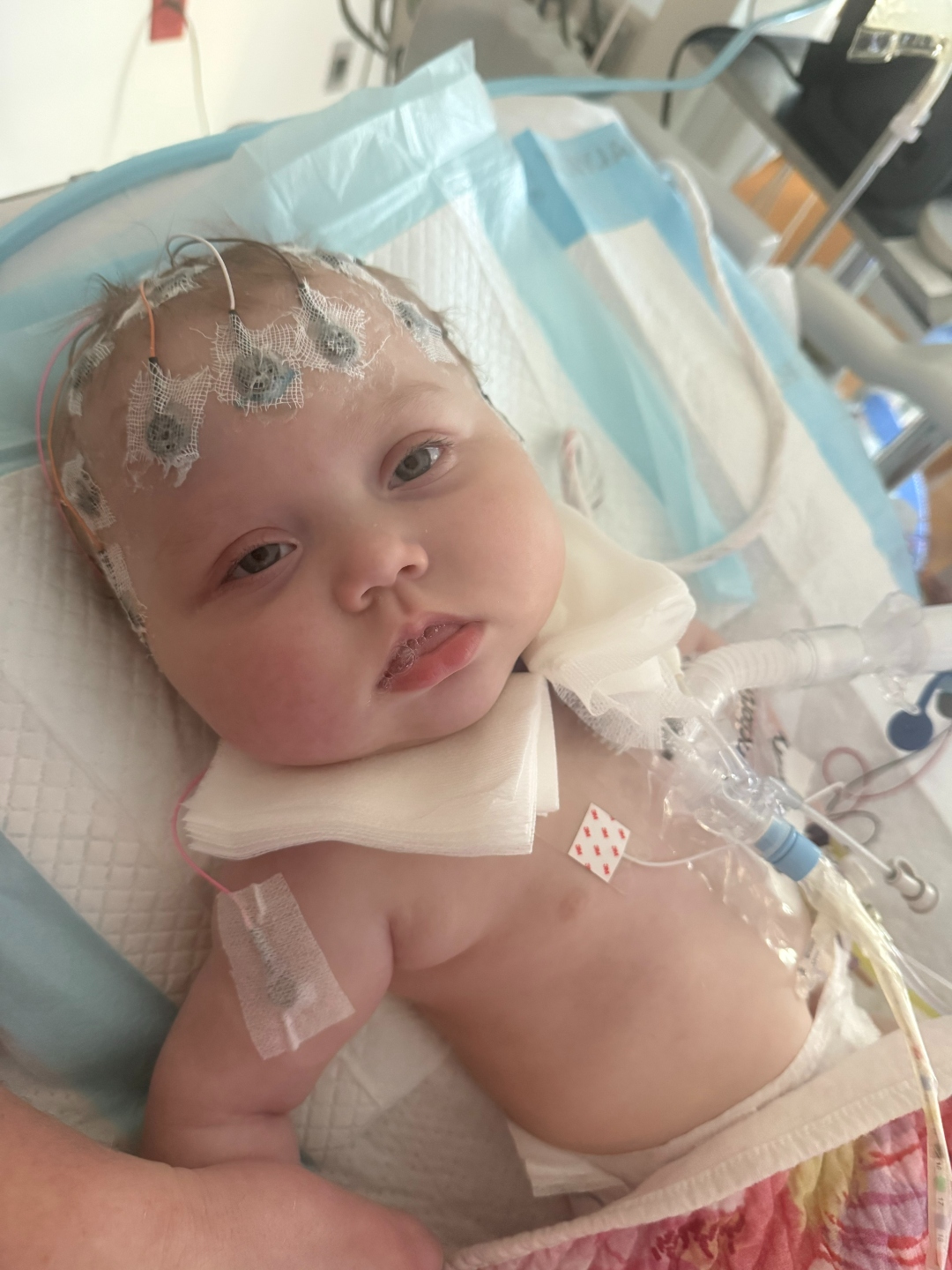
A girl full of light — already rewriting what's possible
Every cell in your body has tiny structures called mitochondria — sometimes called the "powerhouses of the cell" — that convert food into usable energy. In Iris, a rare genetic mutation prevents her mitochondria from doing this job properly. Without energy, her cells struggle to function, and the organs that need the most energy — her brain, her heart, her brainstem — suffer most.
The specific gene responsible is MRPL39, which encodes a component of the large mitochondrial ribosomal subunit. When this component is missing or defective, the mitochondria cannot build the proteins they need to produce energy, creating a cascade of failure throughout her body.
This manifests as Leigh Syndrome — a severe, progressive neurometabolic disease — along with cardiomyopathy, respiratory failure, and gastrointestinal dysfunction that together make Iris's case one of the most complex her doctors have ever seen.
And yet — she smiles. She reacts to her family's voices. She celebrated her first birthday on April 8, 2026, a milestone her medical team once thought unimaginable. Science is moving fast, and Iris's family is working to bring the right researchers to the table. The question is not whether something can be done — it is how quickly we can do it.
What is mitochondrial disease?
Mitochondria are in every cell of our bodies. They use oxygen and nutrients to create the energy currency your cells run on. In mitochondrial disease, this energy production is impaired — not because a cell is damaged from outside, but because the instructions to build the energy machinery are broken from within.
The MRPL39 gene in the nucleus encodes a protein needed by mitochondria. In Iris, this gene is mutated on both copies — blocking energy production cell-wide.
How MRPL39 fits into the picture
The mitochondria have their own set of genes (mtDNA) that encode critical energy proteins. But to build those proteins, the mitochondria need ribosomes — molecular machines that read genetic instructions. MRPL39 is a key component of those ribosomes.
When MRPL39 is non-functional, the mitochondrial ribosomes can't assemble properly, and the mitochondria can't build the proteins they need. This causes broad, downstream failure of oxidative phosphorylation — the process that produces the vast majority of cellular energy.
Iris has compound heterozygous mutations: she inherited one broken copy from her mother (an intronic splice-altering variant) and one from her father (a frameshift deletion). With both copies non-functional, her MRPL39 protein is severely depleted.
RNA sequencing confirmed aberrant splicing with pseudoexon inclusion from the maternal allele, and near-absent correctly-spliced transcript — meaning there is almost no functional MRPL39 in her cells.
What is Leigh Syndrome?
Leigh Syndrome is a severe, progressive neurometabolic disorder of infancy and early childhood. It is caused by defects in mitochondrial energy production and is characterized by symmetric lesions in the brainstem and basal ganglia on MRI — exactly the pattern found in Iris.
Brain Injury Neurological
By 5 months, Iris's MRI showed symmetric metabolic injury to the periaqueductal gray, midbrain, medulla, and deep gray nuclei, with lactate peaks — the hallmark Leigh Syndrome pattern. These brainstem structures directly control breathing and heart rate, explaining her most severe symptoms.
Respiratory Failure Critical
Iris has required tracheostomy and chronic ventilator support due to central respiratory instability. Her brainstem injury impairs the fundamental drive to breathe. She has experienced recurrent life-threatening episodes of apnea and bradycardia, many triggered by autonomic stressors.
Heart Disease Cardiac
Iris developed hypertrophic cardiomyopathy with obstructive features — a thickening of the heart muscle that impairs blood flow. Her cardiomyopathy follows the metabolic pattern typical of mitochondrial disease, with periods of worsening and partial improvement during serial imaging.
Feeding Intolerance GI/Nutrition
From early infancy, Iris had severe feeding difficulties. Modified barium swallow testing revealed silent aspiration across all consistencies. She is fully NPO (nothing by mouth) and requires long-term parenteral nutrition (TPN) via a central line — a major driver of her daily care complexity.
The genetic details that matter to researchers
Iris's case is unusually deeply phenotyped, with serial EEG, MRI/MRS, cardiac imaging, nutritional data, and RNA sequencing all confirming the mechanism of disease. For scientists and clinicians, these findings offer a rare, well-characterized entry point into MRPL39 biology.
Nuclear-encoded component of the large mitochondrial ribosomal subunit. A nuclear target is critical — nuclear genes are far more accessible to gene therapy strategies than pathogenic mtDNA variants.
Maternal intronic c.589-924G>A (splice-altering, pseudoexon inclusion) and paternal frameshift c.526del. Identified by trio whole-exome sequencing.
RNA-seq confirmed aberrant splicing and marked reduction in correctly-spliced transcript. The result: severe loss of functional MRPL39, mitoribosomal instability, and broad downstream loss of mtDNA-encoded OXPHOS proteins.
This is a primary mitochondrial translation defect — not a classic isolated respiratory chain deficiency. The distinction matters for therapeutic targeting: the bottleneck is ribosome assembly, not a single OXPHOS complex.
Medical progression from birth to today
A clinician-focused summary of Iris's disease course, imaging findings, and key medical events. For her personal story, see the homepage timeline.
Iris was born healthy in appearance, but within her first weeks began experiencing episodes of oxygen desaturation, apnea, and bradycardia. Initial workup was inconclusive. Her parents knew something was deeply wrong.
Early brain imaging showed only a punctate white matter infarct likely related to systemic instability. The disease was progressing silently at the cellular level.
Iris developed cardiogenic shock, leading to the diagnosis of hypertrophic cardiomyopathy. This was the first sign of the metabolic cardiomyopathy that would prove to be a central component of her disease.
Follow-up MRI and MR spectroscopy showed symmetric metabolic injury to the periaqueductal gray, midbrain, medulla, and deep gray nuclei, with lactate peaks. The radiologic pattern was unmistakable: Leigh Syndrome.
Trio whole-exome sequencing identified compound heterozygous pathogenic variants in MRPL39. RNA sequencing confirmed aberrant splicing. This gave the family an answer — and a research target.
Iris lives at home with her family, supported by 24/7 nursing care, a home ventilator, and TPN via a central line. She is alert, responsive, and joyful. Her family is actively pursuing research collaboration to develop gene-directed therapies that could change her prognosis — and the prognosis for every MRPL39 patient who comes after her.
This story doesn't have to end here.
MRPL39 is a nuclear gene — which means gene therapy is theoretically possible. One allele carries a splice defect that could potentially be corrected. The researchers who could help Iris may not yet know she exists.